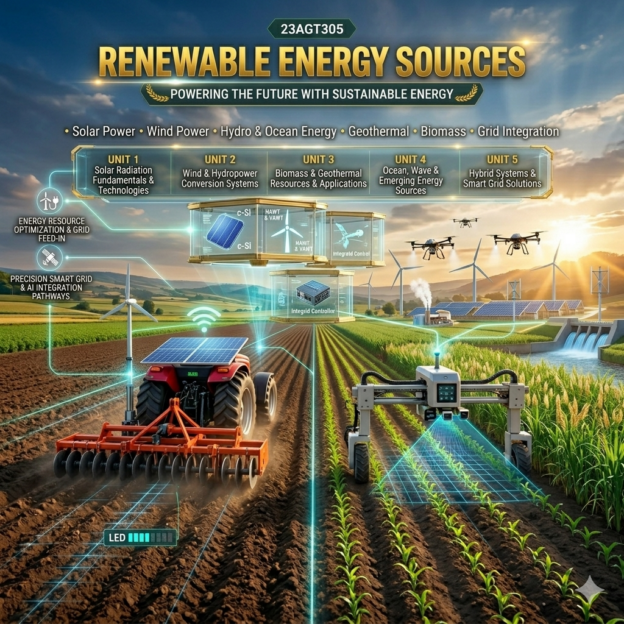
23AGT305 – RENEWABLE ENERGY SOURCES

By Asokan Categories: Agri
Wishlist Share

About Course

Unit I : Introduction to Energy Systems and Resources

Explains conventional and renewable energy sources, global and Indian energy scenarios, environmental impacts, heat transfer methods, thermodynamics, and basics of energy economics and efficiency.

Unit II : Solar Energy Systems

Focuses on solar radiation, solar thermal collectors, photovoltaic (PV) technologies, solar power systems, and applications such as water heating, crop drying, and electricity generation.

Unit III : Wind Energy Systems

Covers wind resource assessment, wind turbine aerodynamics, types of wind turbines, wind energy conversion systems, generators, and wind farm design.

Unit IV : Hydro and Biomass Energy Systems
Introduces hydropower plants, turbines, biomass resources, biogas production, biofuels, and biomass energy conversion technologies.

Unit V : Emerging Renewable Sources and System Integration

Discusses geothermal, tidal, wave, and ocean energy systems along with energy storage technologies, smart grids, hybrid renewable systems, and renewable energy policies.

Show More

What Will You Learn?

  • Understand the classification and importance of renewable and non-renewable energy sources.
  • Gain knowledge about global and Indian energy demand, reserves, and energy policies.
  • Understand environmental impacts of conventional energy systems and climate change issues.
  • Learn the basic principles of heat transfer and thermodynamics in energy systems.
  • Develop knowledge of energy economics, auditing, and sustainability analysis.
  • Understand solar radiation principles and solar energy measurement techniques.
  • Gain practical knowledge about solar thermal collectors and photovoltaic systems.
  • Learn the design and working of solar PV components such as modules, inverters, and batteries.
  • Understand the fundamentals of wind resource assessment and wind turbine aerodynamics.
  • Learn the operation and types of wind energy conversion systems and generators.
  • Gain knowledge of wind farm planning, efficiency, and economic analysis.
  • Understand hydropower systems, hydraulic turbines, and hydroelectric plant components.
  • Learn biomass energy conversion methods including gasification, pyrolysis, and biogas production.
  • Gain knowledge about biofuels such as biodiesel, bioethanol, and biomethane.
  • Understand geothermal, tidal, wave, and ocean thermal energy technologies.
  • Learn the importance of energy storage systems in renewable energy integration.
  • Gain awareness of smart grids, hybrid renewable systems, and microgrid concepts.
  • Understand renewable energy policies, global agreements, and future energy challenges.

Student Ratings & Reviews

No Review Yet
No Review Yet