
23MEB202 THERMAL SYSTEMS ENGINEERING

About Course
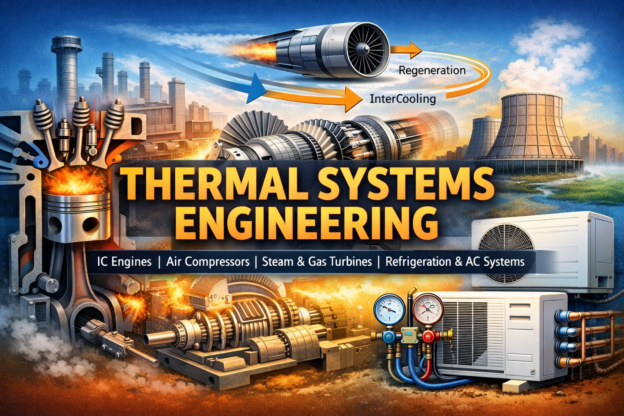
Thermal Systems Engineering introduces the fundamental principles and applications of energy conversion systems used in mechanical engineering. The course focuses on the working, performance analysis, and efficiency evaluation of major thermal devices such as internal combustion engines, air compressors, steam nozzles, steam turbines, gas turbines, and refrigeration and air conditioning systems. Students learn the operation and combustion characteristics of SI and CI engines, performance testing methods, and the thermodynamic analysis of air compressors including multistage compression and efficiency calculations. The course also covers the principles of steam flow through nozzles, impulse and reaction turbines, and gas turbine cycles with performance improvement techniques such as regeneration, intercooling, and reheating. In addition, students study vapour compression refrigeration systems, air conditioning fundamentals, cooling load estimation, and cooling tower operation. Laboratory experiments complement the theoretical concepts by enabling students to analyze the performance of engines, compressors, and refrigeration systems, thereby developing practical understanding of thermal energy systems used in industrial applications
Course Content
Syllabus
Lesson Plan
Lecture Notes
Puzzles
Resource Links
Grades & Toppers
Youtube Videos
Question Bank
Student Ratings & Reviews