Course Content
UNIT I -LECTURE NOTES-Linear Programming Problem
Linear Programming - Formulation - Graphical method and Simplex Method - Formation of Primal and Dual.
0/3
UNIT 2 -LECTURE NOTES-Transportation Problems and Assignment Problems
Transportation Problems: NWC - LCM - VAM - Starting Solution - MODI method - Optimal solution ᎓ balanced and unbalanced Transportation problems (non degeneracy case only) - Assignment problems: Solving balanced and unbalanced assignment problems using Hungarian method.
0/2
UNIT 3 -LECTURE NOTES-Queuing Theory
Queuing Theory - definitions of Waiting Line Model - Queue Discipline - traffic intensity -Poisson Arrival - Birth Death Process - Problems from Single Server - Finite and infinite Population Model.
0/3
UNIT 4- LECTURE NOTES -CPM and PERT
CPM - Principles - Construction of Network for projects - Types of Floats PERT - Time scale analysis - critical path - probability of completion of project.
0/5
UNIT 5 -LECTURE NOTES-Simulation
Simulation: Examples, advantages- limitations - Monte - Carlo simulation - Generation of random numbers - steps in simulation - uses of simulation - Simulation applied to queuing problems - simulation applied to some other types of problems
0/2
Syllabus
21UCL302: RESOURCE MANAGEMENT TECHNIQUES Objectives: The students can enhance knowledge in the following areas such as LPP, transportation problems, assignment problems, Game theory, Queueing models, etc. Prerequisites: Business Mathematics in Higher Secondary level Unit I: Linear Programming Problem Linear Programming - Formulation - Graphical method and Simplex Method - Formation of Primal and Dual. Unit II: Transportation Problems and Assignment Problems Transportation Problems: NWC - LCM - VAM - Starting Solution - MODI method - Optimal solution ᎓ balanced and unbalanced Transportation problems (non degeneracy case only) - Assignment problems: Solving balanced and unbalanced assignment problems using Hungarian method. Unit III: Queuing Theory Queuing Theory - definitions of Waiting Line Model - Queue Discipline - traffic intensity -Poisson Arrival - Birth Death Process - Problems from Single Server - Finite and infinite Population Model. Unit IV: CPM and PERT CPM - Principles - Construction of Network for projects - Types of Floats PERT - Time scale analysis - critical path - probability of completion of project. Unit V: Simulation Simulation: Examples, advantages- limitations - Monte - Carlo simulation - Generation of random numbers - steps in simulation - uses of simulation - Simulation applied to queuing problems - simulation applied to some other types of problems. Text Book: ᎜Recourse Management Techniques᎝ by Prof.V.Sundaresan, K.S.Ganapathy Subramanian and K.Ganesan, .A.R. Publications, March 2011. Unit I: Chapter 2: Sections: 2.1, 2.3, 2.5, 2.6. Chapter3: Sections: 3.1.3, 3.1.4. Unit II: Chapter 7: Sections: 7.1 ᎓ 7.4, Chapter 8: Sections: 8.1 ᎓ 8.6. Unit III: Chapter13: Sections: 13.1 to 13.3, 13.5, 13.6 and 13.8. Unit IV: Chapter 15: Sections: 15.1 to 15.7. Unit IV: Chapter 17: Sections: 17.1 to 17.7. Reference Books Operations Research by Kanti Swarup, Gupta R.K, Manmohan, S .Chand & Sons Education Publications, New Delhi, 16th Edition. 2012, Reprint 2013. Tracts in Operations Research by Kanti Swarup, P.K. Gupta, Manmohan, S. Chand & Sons Education Publications, New Delhi, 11th Edition. 2003, Reprint 2003. Outcomes: Students can gain knowledge in Linear Programming Problem, transportation problem, assignment problem, Game theory, and queuing models. Industry, banks, IT Field, Marketing, Quality control.
0/1
QUESTION BANK
0/1
ASSIGNMENT
0/1
PUZZLE
0/1
NPTEL LINKS
0/1
RESOURCE LINKS
0/1
21UCL302: RESOURCE MANAGEMENT TECHNIQUES

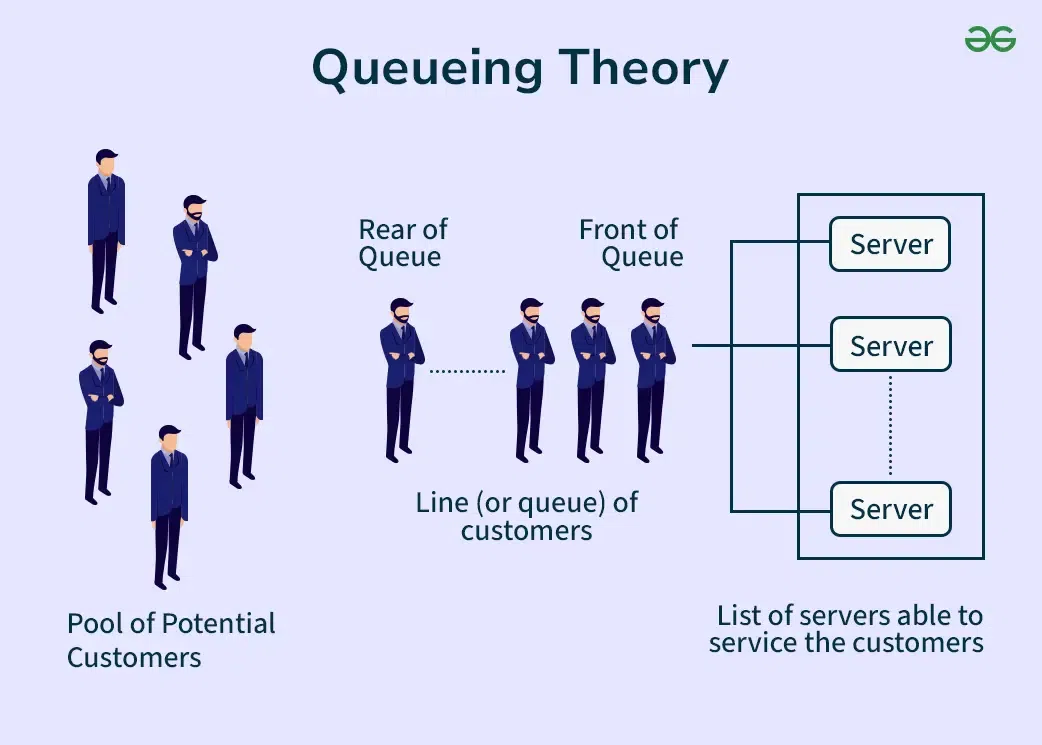
Queuing Theory is the mathematical study of waiting lines (queues). It helps analyze systems where customers (people, data, jobs) arrive, wait for service, and then leaveൔso we can reduce waiting time and improve efficiency.


약쩹 Basic Components of a Queueing System

  1. Arrival Process
    • How customers arrive (random or fixed)
    • Arrival rate = λ\lambda (customers per unit time)
  2. Service Process
    • How customers are served
    • Service rate = μ\mu
  3. Queue Discipline
    • Rule for serving customers:
      • FCFS (First Come First Serve)
      • LIFO (Last In First Out)
      • Priority-based
  4. Number of Servers
    • Single server or multiple servers
  5. System Capacity
    • Maximum number of customers allowed in the system

약쩹 Common Queue Model (M/M/1)

  • M ໒ Markovian (Poisson arrivals)
  • M ໒ Markovian (Exponential service time)
  • 1 ໒ One server

I

 
Exercise Files
QUEUING INTRODUCTION.pptx
Size: 137.46 KB